Migrant Portraiture and Life Imaging in Fazal Sheikh’s Photodocumentaries
DOI :
https://doi.org/10.17742/IMAGE.TP.13.2.3Résumé
Cet article explore le rôle du portrait photographique de migrants dans la construction d’une représentation visuelle de leur vie, en se livrant à une lecture en profondeur de deux ouvrages photographiques du photographe contemporain Fazal Sheikh: – A Sense of Common Ground (1996) et The Victor Weeps. Afghanistan (1998). La narration visuelle est au cœur de l’œuvre sociale et humanitaire de ce photographe, qui pose deux questions principales: Comment les expériences vécues de migration ressenties comme des histoires de survie et les biographies personnelles sont-elles inscrites dans les portraits de réfugiés et de migrants ? Quelles formes de portraits sont choisies et quelles pratiques de représentation sont employées pour documenter la vie des migrants ? S’appuyant sur la théorie du portrait de Jean-Luc Nancy et la notion de Giorgio Agamben de “vie mise à nu,” l’auteur présente une catégorie de procédés analytiques du portrait de communautés de migrants et de réfugiés destinés à expliquer les processus complexes de (dé-)figuration associés au questions de déplacement de populations. À travers son long travail de représentation de communautés de migrants et de réfugiés, et son concept de portraiture relationnelle, Sheikh révèle une pratique de photographie documentaire visant à dé-autériser et démigrer le portrait du migrant en tant que représentation stéréotypée de “l’autre”.Références
Agamben, Giorgo. Homo Sacer. Sovereign Power and Bare Life. Stanford: Stanford University Press, 1998. Print.
Arendt, Hannah. The Origins of Totalitarianism. New York: Meridien 1958. Print.
Azoulay, Ariella. The Civil Contract of Photography. New York: Zone Books, 2008. Print.
Boehm, Gottfried. Bildnis und Individuum. Über den Ursprung der Porträtmalerei in der italienischen Renaissance. Köln: Prestel, 1985. Print.
Cadava, Eduardo. “Trees, Hands, Stars, and Veils: The Portrait in Ruins.” Introduction to Fazal Sheikh. Portraits. Göttingen: Steidl 2011. 5-43. Print.
Jobey, Liz. “Fazal Sheikh: A Sense of Common Ground.” Fazal Sheikh. Exhibition catalogue MAPFRE Foundation. Madrid, 2009. 15-31. Available online under https://www.fazalsheikh.org/fileadmin/user_upload/Fazal-Sheikh/Essays/liz_jobey.pdf.
Mavroudi, Elizabeth, and Caroline Nagel. Global Migration. Patters, Processes, and Politics. London: Routledge, 2017. Print.
Le Masurier, Megan. “What is Slow Journalism?” Journalism Practice, 9.2 (2015): 138-152.
Light, Ken. “Fazal Sheikh. Portrait of a Refugee.” Witness in Our Time: Working Lives of Documentary Photographers. Ed. Ken Light. Washington D.C.: Smithsonian Institution Press, 2010. 153-162. Print.
Nancy, Jean Luc. L’Autre Portrait. Paris: Éditions Galilée, 2014. Print.
Padley, Gemma. “Slow Photojournalism: The Rise of Long-term Assignments.” BBC News 21 December 2015. Available online under https://www.bbc.com/news/in-pictures-35039054. Accessed 6 September 2018.
Römhild, Regina. “Jenseits ethnischer Grenzen. Für eine postmigrantische Kultur- und Gesellschaftsforschung.“ Nach der Migration. Postmigrantische Perspektiven jenseits der Parallelgesellschaft. Eds. In: Yildiz, Erol, and Marc Hill. transcript: Bielefeld, 2015. 37-48.
Sheikh, Fazal. The Victor Weeps. Afghanistan, Zurich: Scalo, 1998. Print.
Sheikh, Fazal. A Sense of Common Ground. Zurich: Scalo, 1996. Print.
Sikking, Iris. “A Thing Called Slow Journalism.” issuu 22 May 2010. Web. https://issuu.com/bintphotobooks/docs/slowjournalism.
Papastergiadis, Nikos. The Turbulence of Migration. Globalization, Deterritorialization and Hybridity. London: Polity, 2000. Print.
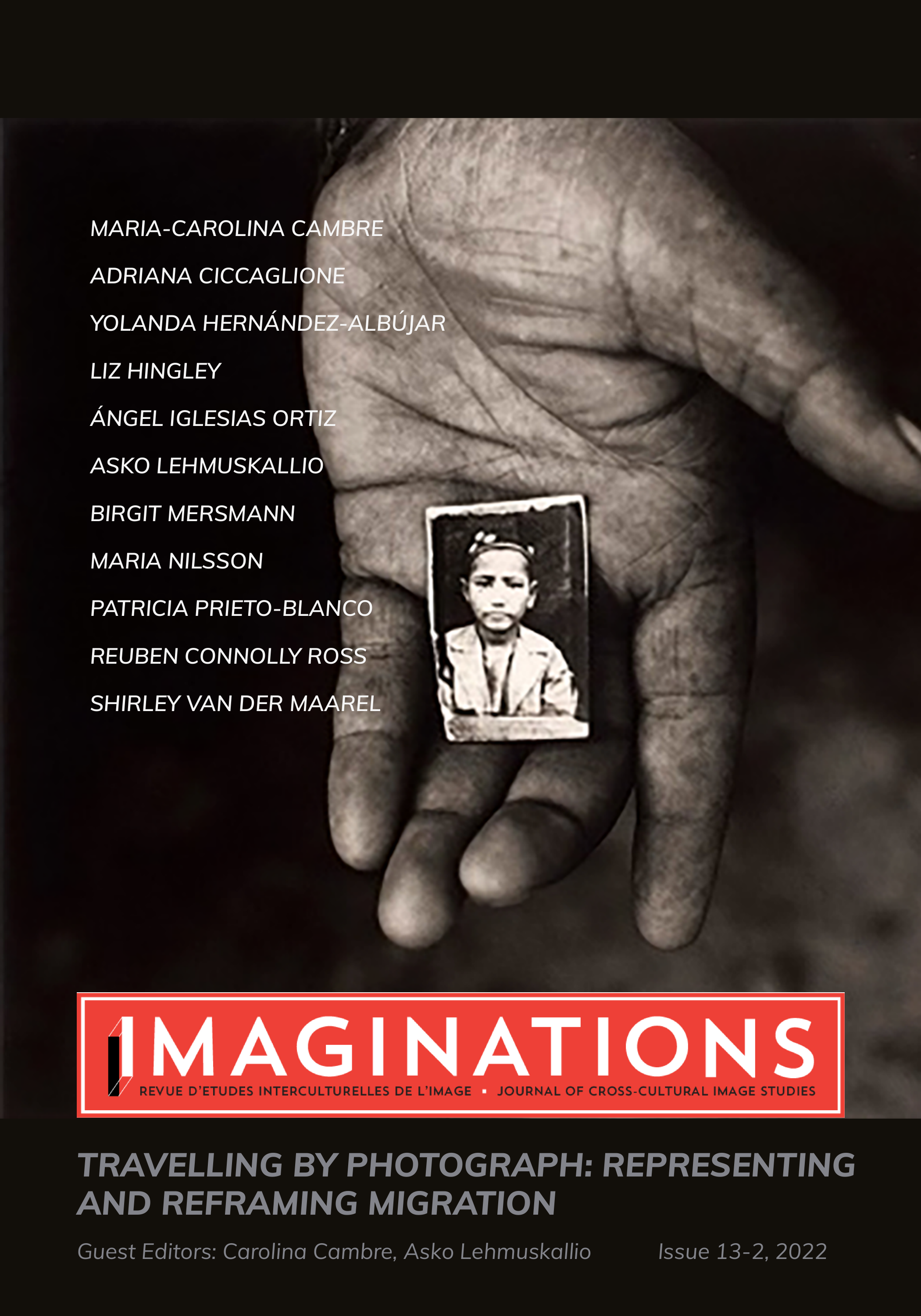
Téléchargements
Publié
Numéro
Rubrique
Licence
© Birgit Mersmann 2022

Cette œuvre est sous licence Creative Commons Attribution - Pas d'Utilisation Commerciale - Pas de Modification 4.0 International.

This work by https://journals.library.ualberta.ca/imaginations is licensed under a Creative Commons 4.0 International License although certain works referenced herein may be separately licensed, or the author has exercised their right to fair dealing under the Canadian Copyright Act.